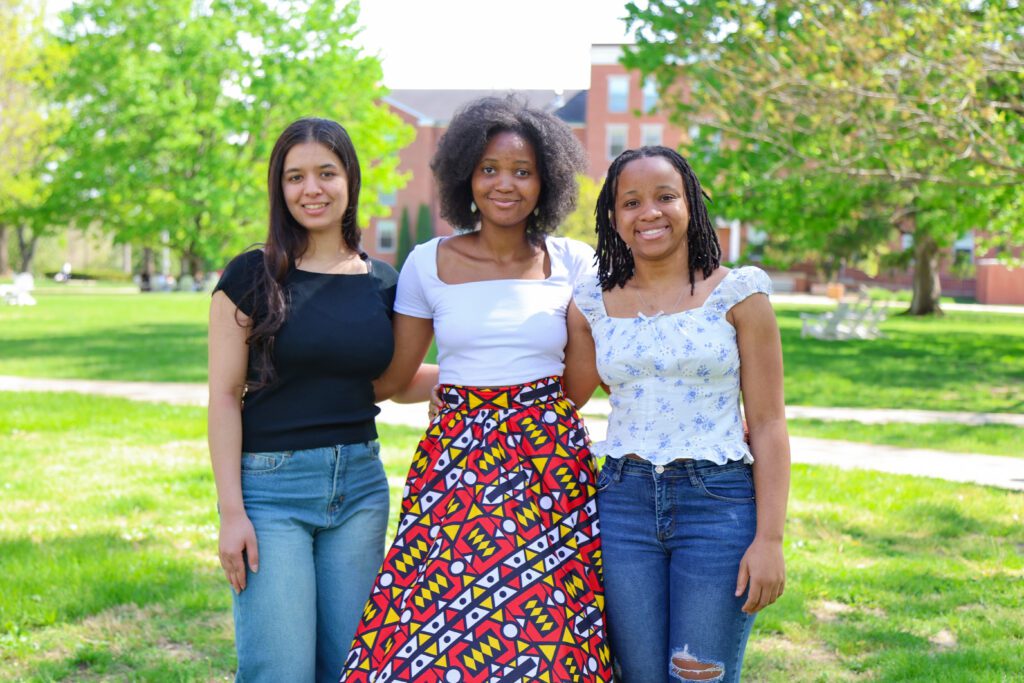
The 2026 Earlham-Ullberg Prize for Environmental Innovation was awarded to two projects this year. The recipients include Urwashi B.K. ‘28, who is exploring repair cafés this summer and their ability to reduce e-waste through salvaging repairable electronics. She will journey through European countries with active repair cafés before meeting with recycling centers in Nepal and India to learn more about the applicability of these programs in her region of origin.
The second prize was a joint award to Gina Manhica ‘27 and Liliana Cauende ‘28, who will travel together this summer to understand how effective and established e-waste recycling in Europe could be used to improve recycling infrastructure in other places, in particular their own home nations of Angola and Mozambique.
The Earlham-Ullberg Prize for Environmental Innovation provides $12,000 in funding for a summer of travel for a student or students who has the vision to do on-the-ground research toward a particular area of environmental innovation.
“We originally designed the Earlham-Ullberg Prize for Environmental Innovation to resemble a ‘mini-Watson Fellowship,’ so one key impact is the learning and personal growth of the winners, which they share publicly via a presentation on campus,” explains Jamey Pavey, who serves on the selection committee for the Earlham-Ullberg Prize and is Earlham’s director of the Center of Environmental Leadership. “Additionally, there is a hope that this more research-based experience might also lead to and inform future applications for things like the Davis Peace Prize, the Hult Prize, or other similar competitions to fund on-the-ground projects.”
The Earlham-Ullberg Prize was made possible by Rohin Ullberg ‘87, who sees great potential in giving these opportunities to thoughtful Earlham students, a group who are already independently motivated to solve interlocking challenges related to climate change and other environmental issues.
For Manhica and Cauende, the challenges of e-waste are personal. They’ve researched and found that less than 1% of e-waste in their home countries is recycled, and the African continent more broadly receives additional e-waste through illegal dumping of e-waste from other nations.
While e-waste often contains small amounts of valuable metals and other supplies that can be recovered, the presence of hundreds of potentially toxic substances within e-waste also makes ad hoc recycling, such as individuals searching for e-waste of value in landfills, particularly dangerous.
The infrastructure needed to create strong e-waste recycling programs requires a combination of governmental policy and compliance, circular economy principles, and investment in safety infrastructure.
Manhica and Cauende are somewhat ideally situated for their efforts: Manhica’s choice to study International Studies and PAGS helps her understand some of the interlocking challenges of both running nonprofit efforts and the international aid landscape, since pilot programs of this nature could be most viable initially as not-for-profit entities.
At the same time, Cauende brings her business management major to the table, looking for opportunities to innovate on the models that work in the countries they’ll visit together (France, Belgium, Germany, Spain and The Netherlands) and adapt them to the distinctions between those country’s economies and the economies of countries like Angola and Mozambique.
For B.K., the focal point of the travels is the concept and execution of repair cafés. While e-waste management handles already-discarded electronics, repair cafés are volunteer organizations that take broken but repairable electronics and make the time to get them back to functionality.
This volunteer effort delays the discarding of a given item and the purchase of a new one, while changing the local perspective on the generation of electronic waste. In economies where e-waste is generating extreme amounts of pollution and dangerous conditions, having the opportunity to train volunteers at repair cafés and safely salvage items that are still able to function is a huge boon to the community.
While repair cafés are often volunteer programs that operate via donations and goodwill generated when visitors save a lot of money by getting to keep using their current electronics. B.K. is exploring the various features of repair café programs in the Netherlands, Belgium, Hungary, Sweden, and Germany, as well as recycling centers in India and Nepal where she’ll learn about the unique needs for recycling and repair in the communities around those recycling centers.
This journey of repair café discovery is connected to her biology major and her interest in environmental health inequalities and public health more broadly, given how much e-waste pollution has created health crises in both her home country and others around the world.
While both proposals tackle the issues of e-waste and how it is impacting countries around the world, the proposals themselves stood out to the committee because of their impact and thorough preparation.
“They both were clearly designed to inform possible solutions to problems the applicants had noticed and personally experienced in their home countries,” explains Pavey. “We, as the selection committee, also found both of the proposals to be very well planned and researched.”
All three of the prize winners will have the opportunity to put their research and personal growth to use with their presentations this fall, as well as through future work in these areas of environmental innovation.
Story written by Laura Leavitt for the Earlham College Office of Marketing and Communications.
***
About Earlham College
Earlham College and Earlham School of Religion foster a collaborative learning community that inspires and motivates students with transformative opportunities and experiences so they can become catalysts for good in a changing world. Located in Richmond, Indiana, Earlham is one of U.S. News & World Report’s Top 100 national liberal arts colleges and offers one of the top 20 classroom experiences in the nation, according to the Princeton Review.
Media contact
Brian Zimmerman
Assistant vice president of strategic communications
Email: [email protected]
Phone: (765) 983.1256