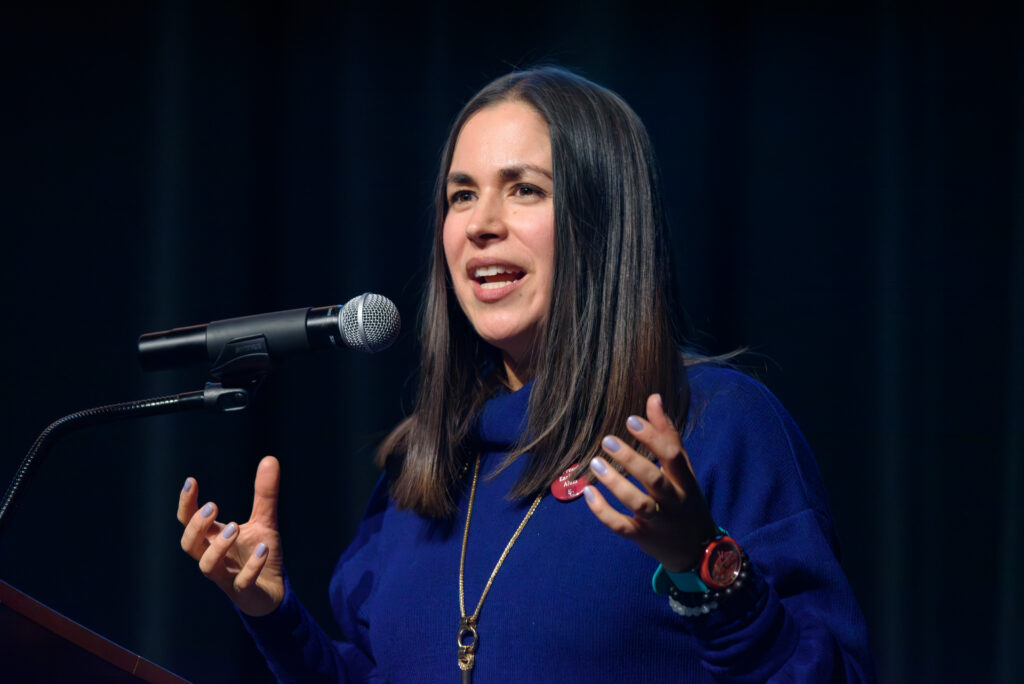
Katie Yamasaki ’99 inhabits a vast and varied creative universe that is perhaps best understood and examined like one might understand and examine a massive mural. Like Yamasaki’s community-centered mural making practice, a mural is sprawling and generous and colorful and intricate. Like Yamasaki’s catalog of deftly illustrated children’s books, a mural tells a wall’s-worth of stories that might otherwise go unseen and unheard. Like Yamasaki’s interwoven life and creative practice, a mural is a world unto itself — teeming with love, light, and possibility.
“What a mural can do is a little bit different than what fine art or other kinds of art can do because it exists in this world with the rest of us — with everybody,” Yamasaki notes.
This sense of being in and of the world radiates from Yamasaki, who self-describes as a children’s book author and illustrator, muralist, art teacher (14 years in public schools), and co-facilitator of arts programs in women’s prisons.
Yamasaki lends support to Earlham in myriad ways to this day (her recent talk at the College’s 2026 Admitted Student Event was a profound and moving hit; her illustration can be found on the cover of this issue of Earlhamite Magazine).
Born to back-to-the-land hippies and raised in a factory town north of Detroit, Yamasaki was regularly awestruck by the Detroit Industry Murals, a series of large frescoes by the Mexican artist Diego Rivera, on display at the Detroit Institute of Arts. In high school, Yamasaki discovered a mural on a small wall on a Detroit street corner created to honor the memory of Malice Green, who had been killed by two police officers.
“I remember being blown away that you could do that — that you could honor somebody’s life, and tell the story of a violent tragedy in this small space. You didn’t have to be Diego Rivera. You could just be somebody with paint — somebody who wanted to take that space and do something important with it.”
In that moment, the seed of what would become Yamasaki’s personal and professional M.O. was planted: she would be a person who used art to, in her words, to “shine light on parts of society and people who’ve been pushed out to the margins.” “Everybody has a voice, but they may not have a platform,” Yamasaki emphasizes.
That seed would be tended by her professors, courses, and community at Earlham and would bloom into a lifelong creative practice. To date, Yamasaki has created over 90 murals, including one for Earlham that hangs in Landrum Bolling Center, published 10 children’s books, and worked in countless countries around the world. Yamasaki arrived at Earlham with a great love for art, virtually no art-making experience, and aspirations toward a career in social work — until an “Intro to Drawing” course changed everything.
“I remember all of a sudden feeling like everything I saw I was seeing with a different eye,” Yamasaki reflects. “Where I would usually just see a table, all of a sudden I was seeing shape and shadow.”
This new appreciation for the visual world and the power that Yamasaki had to shape and share it was one that Yamasaki would cultivate over the next four years in rooms that she remembers as gentle and generous.
“What I appreciated about Earlham was that it wasn’t a cutthroat, comparative, competitive place,” she shares. “Earlham met me at the exact right moment when I felt really open, and provided spaces to walk into where I was constantly amazed by how little I knew and how big the world was.”
Throughout her time at Earlham, Yamasaki continued to thread the needle between building her artistic practice and trying to make an impact beyond the traditional art-world path.
“I felt like Earlham, for all its academic rigor and great reputation, is also a place where you can go and be useful in the world as it is right now,” she said. “They’re not trying to get you to be above anybody or beneath anybody. They want you to be with everybody.”
This idea of “usefulness” in artistic practice would inform her work immensely — and today, Yamasaki’s practice largely sits in the creation of community co-created or participatory murals (markedly different in function and process than the mural-as-advertising or more traditionally solo-self-expressive street art).
One of her most impactful projects, a collaborative mural in East Harlem titled “If Walls Could Talk,” empowered a group of mothers incarcerated at Rikers Island to design a mural for their kids to paint under Yamasaki’s mentorship and vice versa.
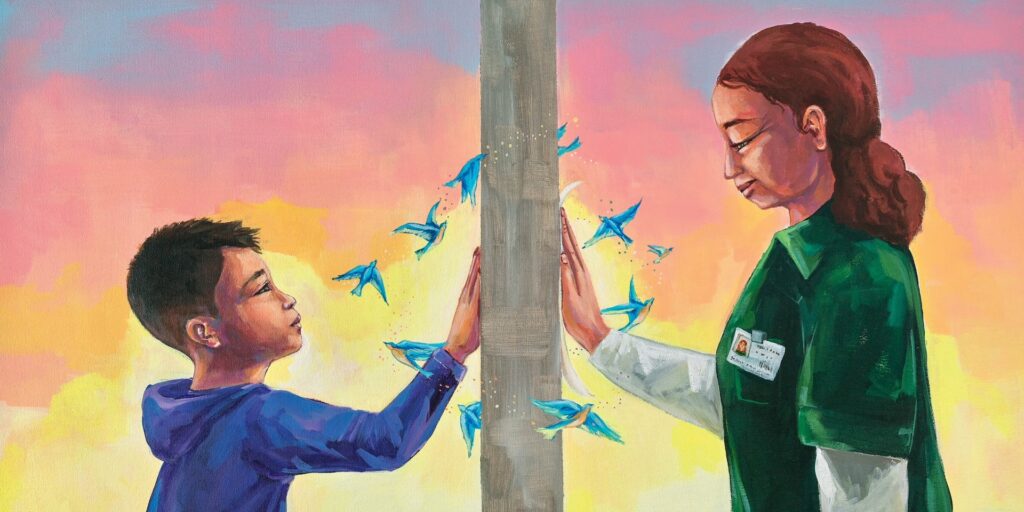
On the first day, one of the moms placed her hand on drawing paper and traced it, and then wrote: ‘When you feel lonely, place your hand here.’ She gave it to me and asked: ‘Can you take this to my sons so that when they miss me, they can place their hand on top of my hand and we can be connected?’ “I remember thinking: ‘What an incredibly useful thing for a drawing to do.’”
The mural and that particular story became the inspiration for “Place Hand Here,” Yamasaki’s award-winning children’s book about a young boy who observes the impact that a mural of a traced hand has on his neighborhood. Yamasaki’s book-making practice is inextricably intertwined with her community arts practice; “Place Hand Here” and the multi-award-winning “Dad Bakes” draw directly from her experiences working with incarcerated and formerly incarcerated folks, while the acclaimed “Mural Island” tells the story of Kengi, a young artist whose travels to Mural Island to teach them about “art, expression, and the communities that cherish both.”
Community-centric arts practice guides Yamasaki’s work as the artist-in-residence at the Women & Justice Project (WJP), an organization whose mission is to work in deep partnership to advance the leadership and build the power of women who are currently and formerly incarcerated. In 2016, WJP engaged Yamasaki to carry out a mural in collaboration with Hour Children, a service provider for incarcerated and formerly incarcerated women in Queens.
“That mural was a testament to the values that guide Katie’s work — integrity, community, love, and the centering of directly impacted people,” said Tamar Kraft-Stolar, Organizational Strategist at Women & Justice Project (WJP) in New York City.
“She works with partnership at the fore of her mind, and the necessity of her approach is magnified in the prison context, where the system is one of dehumanization and punishment,” she said. “It’s a gift for the participants who she partners with in the programs, it’s a gift for the facilitators, and it’s a gift for us at WJP.”
Yamasaki’s gift for partnership was nurtured at Earlham, with its culture of deep collaboration between professors and students. In fact, she was drawn most to Earlham for what she calls its “community feel” — and the sense of responsibility to be in and of that community, and the many communities that have filled her life since then.
“I live with a lot of privilege, and with that privilege, I feel like I have to use whatever tools I can to make things more even in any way that I can.” Yamasaki pauses and considers before sharing a reflection that is decidedly Earlham-in-ethos: “It is not for me to give up on anybody else’s possibility.”
This article originally appeared in the fall 2026 edition of Earlhamite magazine. Story written by Jake Stepansky. Illustrations courtesy of Katie Yamasaki. Photo by Josh Smith.
***
About Earlham College
Earlham College and Earlham School of Religion foster a collaborative learning community that inspires and motivates students with opportunities and experiences so they can become catalysts for good in a changing world. Located in Richmond, Indiana, Earlham is one of U.S. News & World Report’s Top 100 national liberal arts colleges and offers one of the top 20 classroom experiences in the nation, according to the Princeton Review.
Media contact
Brian Zimmerman
Assistant vice president of strategic communications
Email: [email protected]
Phone: (765) 983.1256