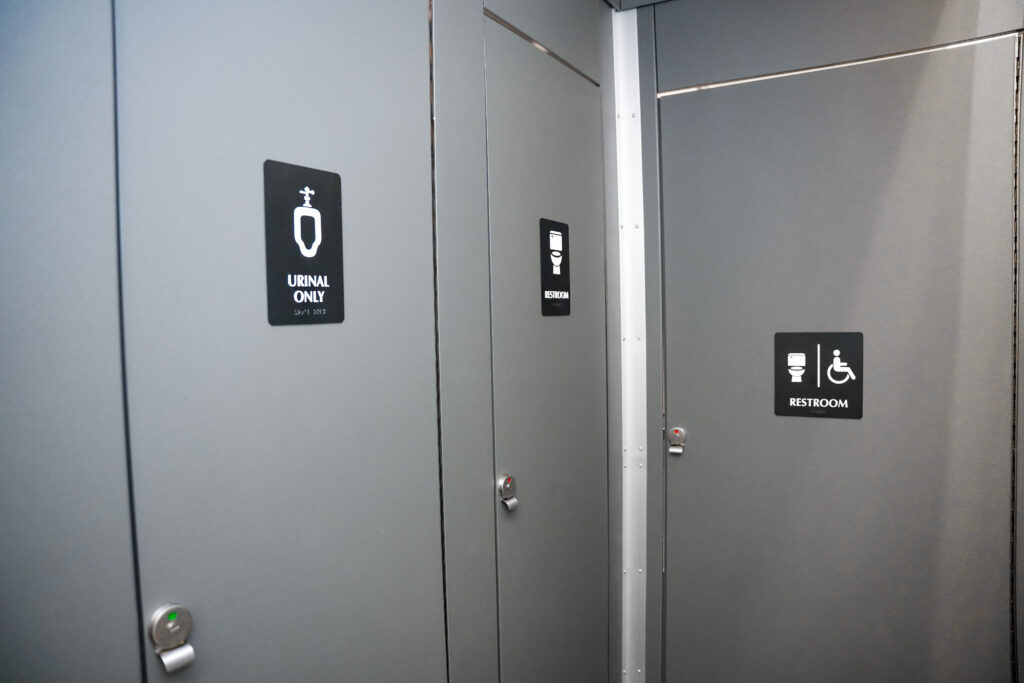
At many colleges and universities, facilities upgrades are typically handled by outside consultants and engineering firms. At Earlham College, a recent bathroom redesign became something more: a hands-on, high-impact learning experience that empowered students to shape a more inclusive campus.
Under the guidance of Whitney Blackburn-Lynch, assistant professor of engineering, recent graduates Rey Jensen-Sizelove ’26, Aoi Maeda’26 and Reeti Joshi ’26 led the transformation of a single-gender restroom into a facility that promotes safety and belonging.
The reimagined bathroom on the main floor of the Center for Science and Technology features six single-occupancy toilet stalls with floor-to-ceiling walls and secure, lockable doors. The project was completed over the summer and updated signage was installed earlier this month.
“The students benefitted from working on all phases of the work — the research, the investigation, the design,” Blackburn-Lynch said. “Now we have students who graduated with a finished project on their resume. They can point to something and say, ‘that was me!’
The team began its work in July 2025 as part of a College-sponsored summer collaborative research project. They began by researching state and local building codes, occupancy requirements, accessibility standards, and plumbing and mechanical constraints. Along the way, they also got an introduction to Indiana’s building standards—where they learned, for example, that a bathroom, a lavatory, and a water closet carry different meanings from an engineering perspective. They also produced detailed drawings and schematics, developed cost estimates, and collaborated with National Management Resources, Earlham’s facilities management partner.
“Whitney provided a lot of support but gave us opportunities to work and grow independently,” said Jensen-Sizelove, who majored in engineering and plans to pursue a career in ecological engineering.
“This project helped me in further developing applicable engineering skills, such as creating physical and digital designs, understanding codes and regulations, and communicating with my team and supervisor,” they said.
Project leaders estimate the faculty-student collaboration saved the College up to $60,000 in pre-construction costs.
“This is exactly the kind of work we want students to do: solving real problems, navigating challenges, and collaborating with professionals,” Little said. “At the same time, projects like this allow the College to be a responsible steward of resources. Students produced work comparable to what we would typically contract out, and they’ll be able to point to something tangible that will serve the campus for years.”
The project grew out of campus conversations about inclusive restroom access that began about a year and a half ago when Blackburn-Lynch, a licensed engineer in Indiana, agreed to take on the work.
“The Center for Science and Technology is one of the busiest academic buildings on campus and is one of the only spaces that doesn’t have a gender-neutral bathroom,” Blackburn-Lynch said. “I knew what was required to transform the space into something that could better serve our community.”
In addition to the engineering work, Blackburn-Lynch and her students created a public display and circulated a campus-wide survey to gauge community response. Students and faculty overwhelmingly supported the proposed restroom, Blackburn-Lynch said, affirming both the design and the need for inclusive bathroom facilities in the building.
“It’s a great example of what’s possible when our students get to do that work, but it also demonstrates that we help each other here,” Blackburn-Lynch said. “Our students care deeply about each other and do high-quality work.”
Earlham is one of the few national liberal arts colleges in the United States to offer a full, four-year undergraduate degree in engineering. The program emphasizes technical rigor alongside ethical reasoning, community engagement, and applied problem-solving. The College also offers a 3+2 pre-professional pathway where students earn two degrees — a Bachelor of Arts from Earlham and a Bachelor of Science from a partnering engineering school — offering students a liberal arts education alongside technical preparation. Earlham’s 3+2 partners include Case Western University, Washington University of St. Louis, Columbia University, and Rensselaer Polytechnic Institute.
Blackburn-Lynch’s own career reflects this interdisciplinary approach. Trained as an environmental engineer, she holds a Ph.D. in biosystems and agricultural engineering from the University of Kentucky, a master’s degree in environmental engineering from Duke University, and a bachelor’s degree in mathematics from Berea College. She has worked in government permitting and reclamation design and taught at community colleges and R1 universities before realizing a long-held goal of teaching engineering at a liberal arts college.
***
About Earlham College
Earlham College and Earlham School of Religion foster a collaborative learning community that inspires and motivates students with opportunities and experiences so they can become catalysts for good in a changing world. Located in Richmond, Indiana, Earlham is one of U.S. News & World Report’s Top 100 national liberal arts colleges and offers one of the top 20 classroom experiences in the nation, according to the Princeton Review.
Media contact
Brian Zimmerman
Assistant vice president of strategic communications
Email: [email protected]
Phone: (765) 983.1256