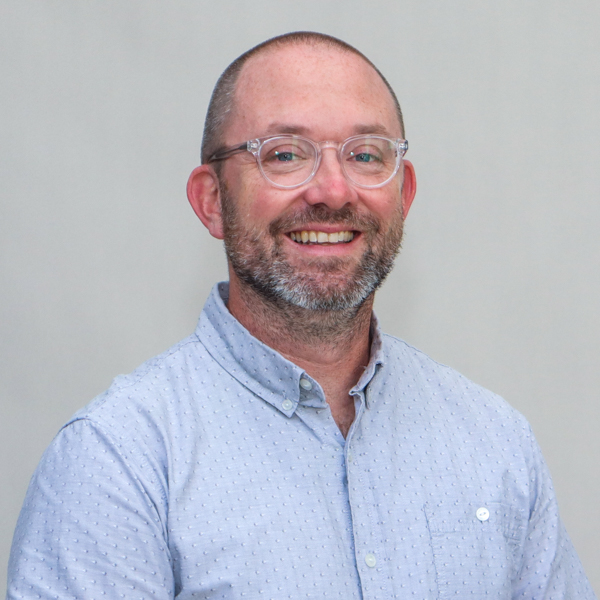
Nathan Sheets
Director of Annual Giving
Phone:765.983.1561
Email:[email protected]
Pronouns:he/they
Location: Carpenter Hall, Office 100K
About Me
I am a native to Richmond, but with my family I returned after nearly two decades away in December of 2023. In March of 2024 I became Earlham’s Director of Annual Giving, a position where I oversee a comprehensive strategy to raise essential funds to support student access and opportunity at Earlham.
Previous to coming back to Richmond, I served as Executive Director of The Center in Hollywood; a regional-leading non-profit organization addressing homelessness in greater-Los Angeles. At The Center I worked alongside fellow community members (both housed and unhoused) to develop innovative programs focused on low-barrier entry and harm-reduction strategies for the unhoused community. Much of what gave/gives the work meaning for me and others was/is the devotion to providing ‘radical hospitality’ through a range of groups and engagement opportunities wherein people were not only able to tend to immediate needs (e.g. having a mailing address, using the restroom), but also offered community connections which follow(ed) them into (and throughout) their recovery and/or in housing.
During that time I also served on the founding board of Hollywood 4WRD, a regional-collaborative coalition advocating for sustainable solutions to addressing the region’s homelessness crisis, and specifically for the regions most-vulnerable unhoused community members.
Currently, I serve on Richmond’s mayoral-appointed Board of Zoning Appeals, Housing Authority Board of Commissioners, and the City of Richmond Board of Public Works and Safety.
Education
- M.A., Santa Clara University
- B.S., Ball State University
Scholarly interest
I am interested in the evolution of faith communities, and their roles in society with current changing social need(s). Specifically, much of my study and interest has involved identifying exemplars of religious/faith communities whose historically-inward focused congregations have been evolving to utilize ‘sanctuary’ spaces for at-risk community needs. These congregations have served as models for others grappling with dwindling membership, and negative perceptions, with (simultaneous) increased need(s) for affordable housing development, day care availability, and safe space for at-risk community groups. The connection to a refreshed translation of sacred text and social teachings in light of American contemporary life intersects with this particular interest as well.