Earlham College Academic Fair
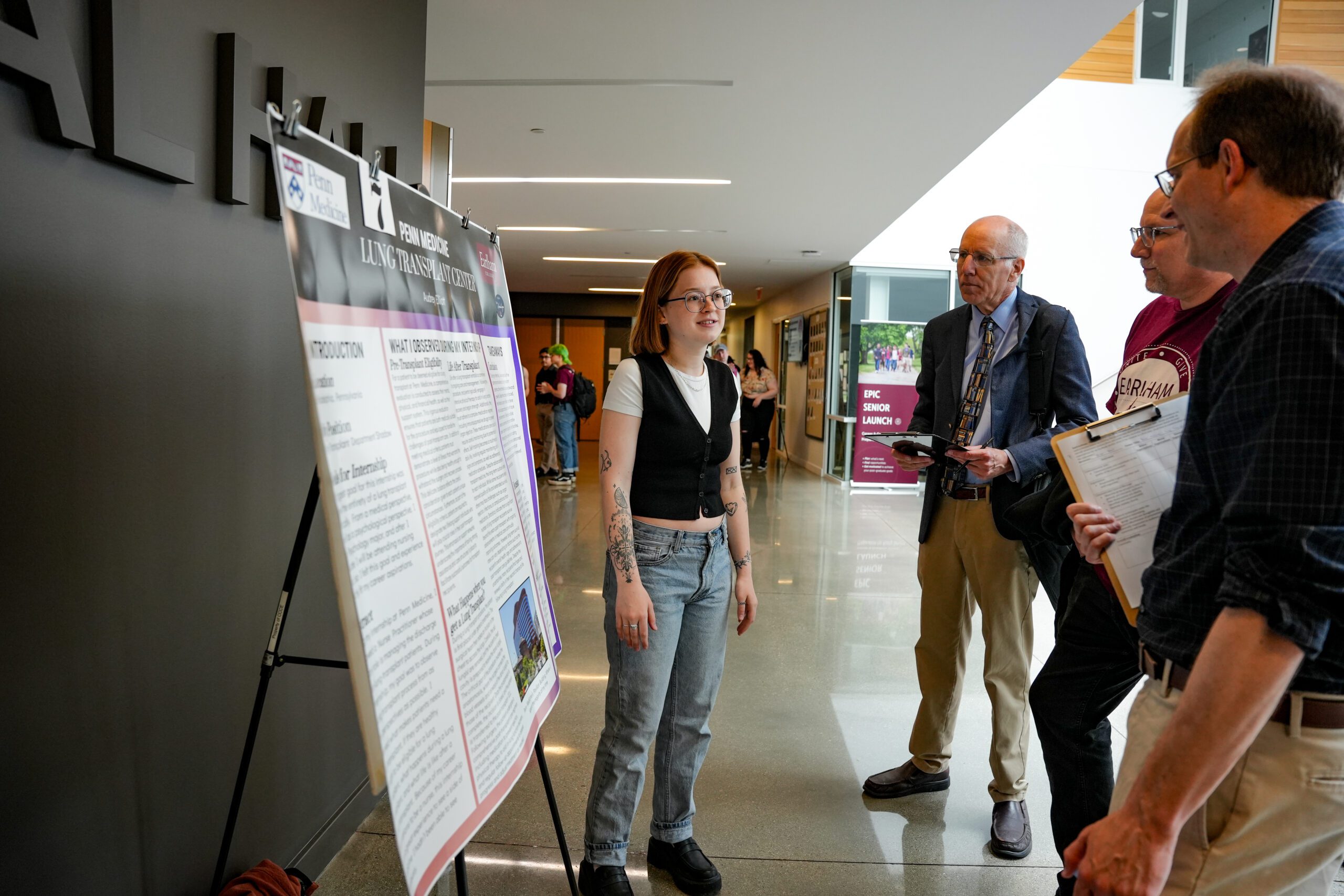
Join us on April 22, 2026 as Earlham College celebrates the outstanding work and achievements of students and faculty across the full range of the academic curriculum, including classes, collaborative research projects and creative performances. The event includes panel presentations, roundtables focused on group discussion, poster presentations, and musical performances.
Schedule of events
Morning concurrent Sessions (9-9:50 a.m.)
Various locations
Erik Erikson’s theory of human development defines generativity as a concern for nurturing, guiding, and ensuring the well-being of future generations. While most naturally experienced within families, generativity can also be met through various non-family mentors and in several ways including journal entries, stories, and even modern media. A wide spectrum of paths can be taken to achieve generativity, yet, each consistently provides meaning and direction to our lives. This study involves interviews with Earlham College students and retirement home residents to discover differing levels of generativity and their origins. The Social Generativity Scale will be used to numerically assess these levels. They’ll be paired with a consistent list of questions to explore who inspires them and in what ways it’s been done. With the assumption that higher levels of generativity lead to a happier and healthier life, the influence of negative stories is also recognized. The hypothesis is that a richer array of positive experiences and information passed down from mentors will lead to higher levels of generativity in individuals.
When introducing mindfulness-based stress reduction (MBSR) techniques to those who have experienced significant trauma, special care must be taken. Learners often feel significant pressure to practice daily, for a certain amount of time, and in a specific way. However, trauma predisposes us to fail to meet these standards. Additionally, since those with ADHD and/or autism spectrum disorder (ASD) are more likely to experience trauma, difficulties with time management and emotional regulation that come with these disorders make these standards even farther out of reach. As a result, trauma-informed methods of teaching MBSR are essential to ensuring the practice is accessible to everyone. Utilizing MBSR as it is presented in dialectical behavioral therapy (DBT) and encouraging learners not to pressure themselves into practicing mindfulness with a level of exactness that is inaccessible to them.
Khalid will be discussing the influence of Indigenous Wayuu folklore in One Hundred Years of Solitude by Gabriel Garcia Marquez, and its relationship to mestizaje which was key to the founding of Colombia’s national modern identity. Cyrus will criticize the way Richard Rodriguez describes the impacts of affirmative action in his memoir Hunger of Memory. By examining his methods and perspectives, Cyrus will analyze the flaws in his arguments. Note this presentation will primarily be in Spanish.
A collaboration between two music majors! First-year piano performance major Kevin Adler and junior composition major Alice Howard are excited to share their music with you. Each will discuss their musical journey at Earlham and play selected pieces. Particularly featured will be a modern spin on a minuet, written by Alice and performed by Kevin. Total performance length will be roughly 20 minutes.
Poster sessions (10:00-11:30 a.m.)
Lilly Library main floor
1. Giselle Nishimwe, “Medical Humanities: How Racism Mediates Health Care”
2. Shubhangini Shah, “Health is not just biological: Insights from community-based care”
3. André Moriel, “Humanizing Rehabilitation: A Physical Therapy Internship Experience”
4. Sohyun Park, “Understanding Dental Care Barriers Among International Students at Earlham College”
5. Pedro Conci Rodrigues, Sohyun Park, Yeongin Jin, and Shio Sawada, “Terratunity: Bridging Science and Indigenous Communities for Ethical Co-Creation”
6. Abbie Gentry, Yeongin Jin, Carlos Rojas, Shio Sawada, and Stella Shannon, “Early Spring Phenophases of Native and Invasive Species in Richmond, Indiana”
7. Ted Eastman, Django Farlice, Maellynn Karuranga , Dakota Lamm, and Katleho Mokhele, “Soil Organic Matter Across Land-use Types in Richmond, IN”
8. Grace Baldwin, Annmery Katto, Sofía Zuniga Carrillo, Jewel Schoettmer, and Preston Scott, “Soundscapes and Sound Pollution: Biophony, Geophony, Anthropophony in Richmond, IN”
9. Mary Kaitlyn Bauer, Emily Cason, Savanna Hilbert, Levi Smith, and Isaac Stiles, “Wildlife Activity in Earlham College’s Backcampus Wetland”
10. Moises E Zacatelco, Lena R Bill, Sarah G Osburn, Aija M Bowman, Emerson G Tallitsch, Harley G Pickett, Sara C Lindower, Josh Angell, Wendy P Tori, and Jaime Coon, “Interacting Impacts of Climate and Pasture Management on Grassland Birds and Plants”
11. Dawt Sang, Gabrielle Watkins, and Jesse Musinguzi, “Under the Sea…quencing: Nanopore Detection of Aquatic Species”
12. Milan Nettl. Urwashi BK, Sachithra Manamalage, “Chemical tests for rapid testing of lead concentrations in dust”
13. Maryam Huggi, Isaiah Mayers, and Natalee McCann, “Social Psychology Replication Project”
14. Havyn Abrams-Glosser, Avril Newsome, Claudia Utomo, and Eleanor Wilson, “Social Psychology Replication Project”
15. KJ Hillhouse, Bryden Morris, Ryan Polack, and Khalime Truell, “Social Psychology Replication Project”
16. Morgan Haisten, Carmen Osiecki, and Lindle Osiecki, “Social Psychology Replication Project”
17. Lucy Couch, Don Papa Fall, and Eleanor Venditti, “Social Psychology Replication Project”
18. Mackenzie Berry-Stricklen, Ashanti Bradley, and Kamryn Jarvis, “Social Psychology Replication Project”
19. Nessah Akuaku, Mo Al Abdul Rahman, Miles Gilchrist, and Cierra James, “Social Psychology Replication Project”
20. Dane Copeland, Harry Dennison, Austin Jaunarajs, and Clay Kruger, “Social Psychology Replication Project”
21. Devabrat Das, Alice Gamboa, Jasper Huneycutt, and Will Jung, “Social Psychology Replication Project”
22. Avery (Art) Crockett, “No, You Cannot “Chris McCandless It”: My Experience With Self-Led Wilderness Meditation”
23. Ekaterina Marchenko, “Contemplative Studies at Earlham: What Is Contemplation, Really?”
Afternoon concurrent sessions (1:00-1:50 p.m.)
Various locations
Gather a collection of our new genetics-based Zines, hot off the presses. Students from Biol 351: Human Genetics and Genomics will share Zines (hand-made magazines) they created describing social issues in genetics. Our Zine Soft Launch comes before our public launch on Saturday April 25th (DNA Day) at Oblivion Cinema and Arts. We will engage with you on multiple topics, which include why race is a social concept not a genetic one, how ancestry tests work and what they do and don’t tell you, racial disparities in genomics, genetic diversity within and between populations, the origins of race and how our definitions change over time, Native Americans and DNA studies, concerns surrounding pre-implantation genetic testing and links to eugenics, AND MORE!
In these two research projects, Max Firestine and Carter Brownrobie both take a deep dive into imperative urban conflicts that shaped urban life throughout the 20th and into the 21st centuries. In our research, we examine what has transpired in cities like Detroit and Cincinnati, which have had such a drastic effect on the overall development of the urban landscape in those areas. In terms of Detroit, Max Firestine will be looking into conflicts between the African American population and those in authority, along with the various forms of racial profiling put upon them, leading up to the race riots of 1967. In the Cincinnati area, Carter Brownrobie will focus on a transportation labor shortage in late 1967. Our findings contribute to broader historiographical debates on a range of issues in United States urban history, including labor, race, housing, and law enforcement. The history senior capstone project taught by Elana Passman brings together all graduating history majors to write an original thesis by conducting advanced primary and secondary research.
Students graduating from the Sociology/Anthropology Department (SoAn) and the Media & Communications Program (MCOM) will present concise summaries of their Capstone Theses and/or Projects.
Elijah Anderson, “Zohran Mamdani’s Campaign and the Trajectory of American Socialism”
Dorian V. Campbell Himes, “DIY in the Post-Industrial: An Ethnographic Study of Dayton, Ohio’s Alternative Music Community”
Dylan Gayle, “Voluntary Student Withdrawal: What the Research Reveals and Strategic Implications”
Ashlin S. Pfeifer Winborn, “Mutual Aid and Voluntary Associations in Harrisburg, Pennsylvania”
Brady J. Shaw, “Revitalize Richmond”
Presenters in this session will share policy briefs developed around the following environmental health focused topics: regulation of PFAS in drinking water, regulation and reduction of persistent organic pollutants, and policies to encourage energy efficiency with AI data centers. Each presenter will provide a background of the issue, including current policy approaches, and offer alternative policy approaches that might more effectively address the issue.
Afternoon concurrent sessions (2:00-2:50 p.m.)
Various locations
Presenters in this session will share policy briefs developed around the following topics: application of “Waters of the United States” definition to wetlands, sea level rise, wildfire prevention and mitigation on federal lands, and endangered species protection. Each presenter will provide a background of the issue, including current policy approaches, and offer alternative policy approaches that might more effectively address the issue.
Come see how THEA484 Faculty-Student Collaborative Research participants devised a world premiere theatrical production adapted from a novel by local author, Kathryn Clare Glen, The Continuing Misadventures of the Hathaways: Captain McNamara’s Revenge. Students will share how their individual and group research guided decisions about script revisions, informed collaborative staging development workshops, and inspired student sound and puppet designs as well as original music compositions. See examples of the creative processes through which multiple points of view were integrated into the cohesive performances shared with audiences April 16th, 17th, and 18th. Feedback from preview audiences, professional colleagues, and community partners will now inform plans for revision before August performances at the world’s oldest and largest arts festival, the Edinburgh Festival Fringe. Students will also share how they gained practical experience and developed entrepreneurial skills as they created marketing and production management schedules and practiced a form of self-governance called Caring Community Collaboration Practices.
Students graduating from the Sociology/Anthropology Department (SoAn) and the Media & Communications Program (MCOM) will present concise summaries of their Capstone Theses and/or Projects.
Robert D. Gift “Crisis Communication in Sports: Capitalism, Spectacle, and the Commodification of the Athlete”
Khalid Kishawi, “Rethinking Countercultural Communities & Cannabis: The Community of Salmon Creek in Humboldt County, California”
Aoi Maeda, “Sasukyu, Social Media, and the Gender Gap in Japan’s Kyushu Region”
Carly C. Mays, “Anonymity, Stigma and Survival: Disclosure and Discretion in Telling the Stories of Addiction”
Ryan will present on Sylvester Graham and John Harvey Kellogg, and how they have impacted American healthy living. Lucas will present on the interplay between James Hoffa and Robert F. Kennedy during and after the Select Committee on Improper Activities in the Labor or Management Field. The history senior capstone project taught by Elana Passman brings together all graduating history majors to write an original thesis by conducting advanced primary and secondary research.
Faculty Recognition Event (3-3:50 p.m.)
Center for Visual and Performing Arts Atrium
Spring Awards convocation (4-5 p.m.)
Goddard Auditorium
Livestream