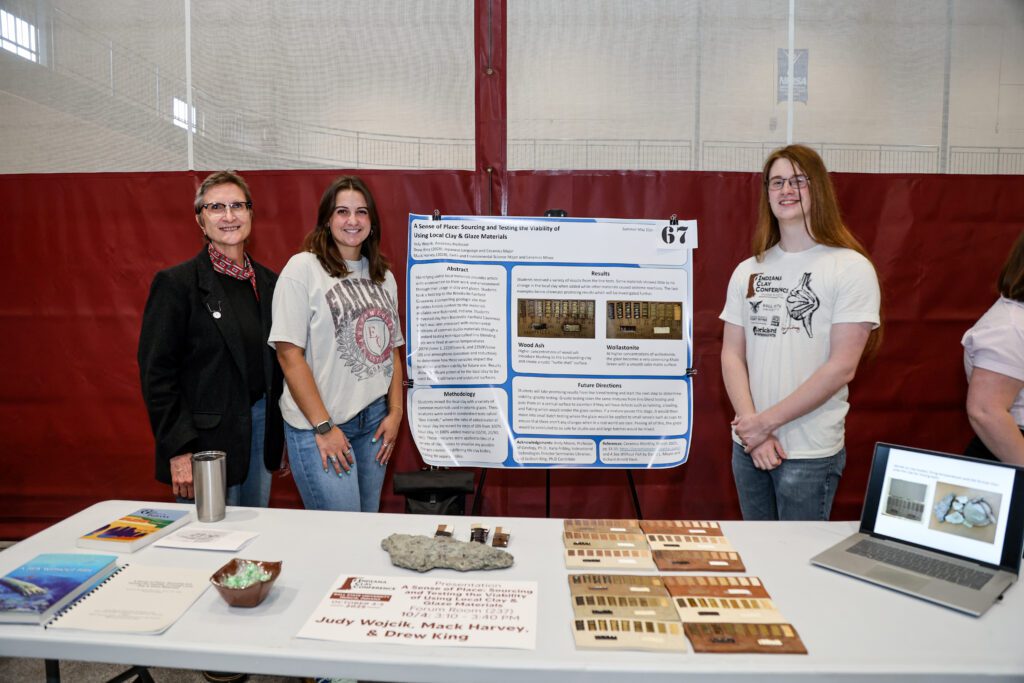
In a creative blend of science and art, Earlham students Drew King ‘28 and Mack Harvey ‘28 worked alongside Judy Wojcik, associate professor of art, to research the viability of utilizing local clay and glaze materials in ceramics. The collaborative project investigates how artists can reduce environmental impact by using resources found close to home, while deepening their connection to both their work and the environment around them.
Their project, “A Sense of Place: Sourcing and Testing the Viability of Using Local Clay and Glaze Materials,” began as a three-week summer faculty-student research project inspired by Wojcik’s previous sustainable ceramics course.
“The idea started when we transitioned from using a wood kiln to the gas and electric kilns in the new CPVA facility in 2014,” Wojcik explained. “I was curious about how different materials would fire in the new kilns and was exploring ways to incorporate more sustainable materials in the process.” As students of Wojcik, King and Harvey caught interest in the project, leading the trio to start experimenting.
They set out to identify local materials that would serve as viable clay and glaze in ceramics projects. King and Harvey took a field trip to harvest clay from the Brookville Fairfield Causeway, a compelling geological site that offers historic context to the materials available near Richmond, Indiana.
“The geological aspect was one of my favorite parts,” shared Harvey. “I loved being able to take the samples and learn the geological history of the clay we were collecting.”
After gathering samples, Wojcik and her students took their clay to the studio to prepare for testing. Through a process called line blending, 90 test tiles were created with incremental additions of common studio materials and fired at various temperatures and atmospheres to determine their impact on the local clay and the glaze’s viability for future use.
“Being able to run tests and review the results was exciting,” King said. “I liked seeing the results come out of the kiln and being able to identify different applications for the glazes we made.” Their results showed significant potential for the local clay to be used in both utilitarian and sculptural surfaces.
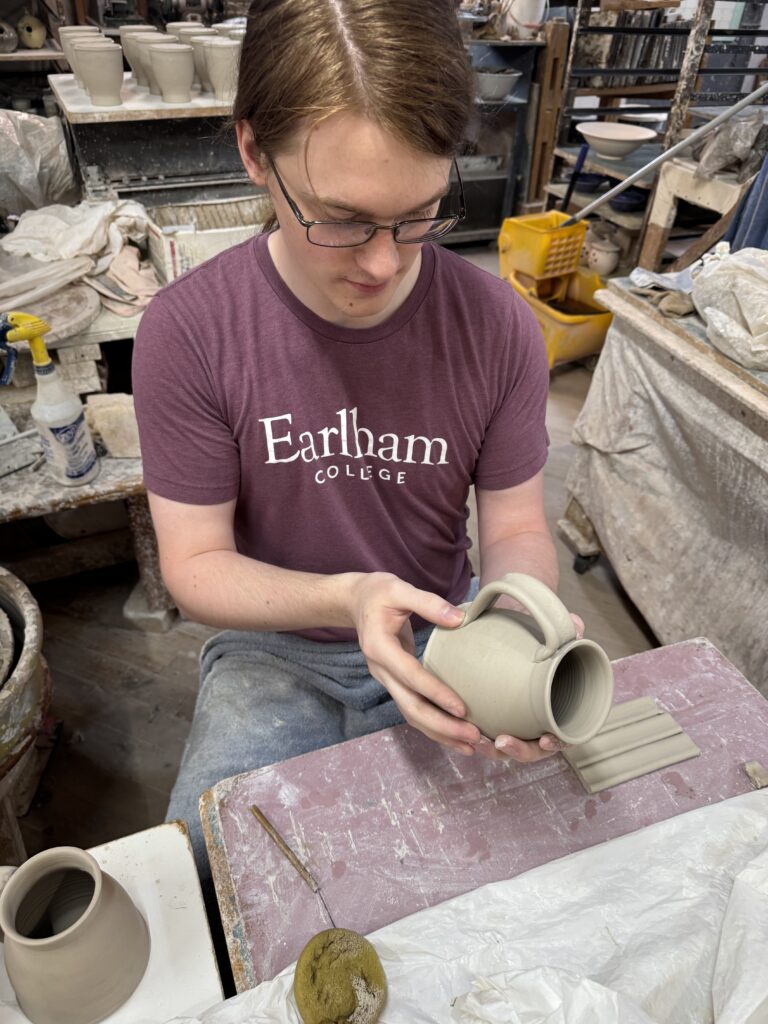
“Being able to run tests and review the results was exciting. I liked seeing the results come out of the kiln and being able to identify different applications for the glazes we made.”
— Drew King ’28
As the team continued to refine their methods, their discoveries underscored the educational and community value of linking artistic process with environmental responsibility. When it comes to ceramics, materials can come from a wide range of places, whether it be from local clay or from materials and glazes shipped from all around the world. This can serve as a problem, both for the environment and for accessibility of materials, when it comes to mining and shipping the components that go into processing the clay and glazes used in the studio. Wojcik and her students’ research works to address these issues.
Wojcik explained the unique sense of place tied to making a piece in ceramics, noting that the ties an artist has to their work can come from a variety of sources. By being involved throughout the entire process, from gathering local clay to the formation of a piece, the team describes a resulting deeper connection to their craft and a more sustainable and accessible end creation.
“This project really taught me to appreciate the resources I have available,” shared Harvey. “The work brought a deeper meaning to all the parts that come together to make the materials we use.”
Beyond the studio, students were eager to share what they learned, showcasing their work and insights with the community to spark dialogue about the relationship between art, environment, and place. The team presented their research at the 4th Biennial Indiana Clay Conference at Ball State University and this year’s Epic Expo on Earlham’s campus. Their presentations demonstrated their research progress and encouraged consideration for how their practices could have the potential to make ceramics more accessible to students, particularly in areas with limited funding for expensive resources.
By presenting at scholarly conferences and Earlham’s Epic Expo, students strengthen their leadership skills and gain experience that translates beyond the classroom. These opportunities prepare them to navigate professional settings with confidence, communicate effectively, and take initiative in their future careers.
Looking ahead, Wojcik and her team plan to continue testing glazes with a focus on viability during gravity testing, which “takes the same mixtures from line blend testing and puts them on a vertical surface to ascertain if they will have defects such as running, crawling, and flaking, which would render the glaze useless.”
Any mixtures that pass gravity testing will be moved into small-batch testing, where the team will determine if the glaze will hold up in real-world use.
“The goal is to be able to create an entire piece from locally sourced materials,” Wojcik shared. “Our initial results are very promising, and we’re excited to continue our work and see where the research leads.”
***
About Earlham College
Earlham College and Earlham School of Religion foster a collaborative learning community that inspires and motivates students with transformative opportunities and experiences so they can become catalysts for good in a changing world. Located in Richmond, Indiana, Earlham is one of U.S. News & World Report’s Top 75 national liberal arts colleges and offers one of the top 20 classroom experiences in the nation, according to the Princeton Review.
Media contact
Brian Zimmerman
Assistant vice president of strategic communications
Email: [email protected]
Phone: (765) 983.1256