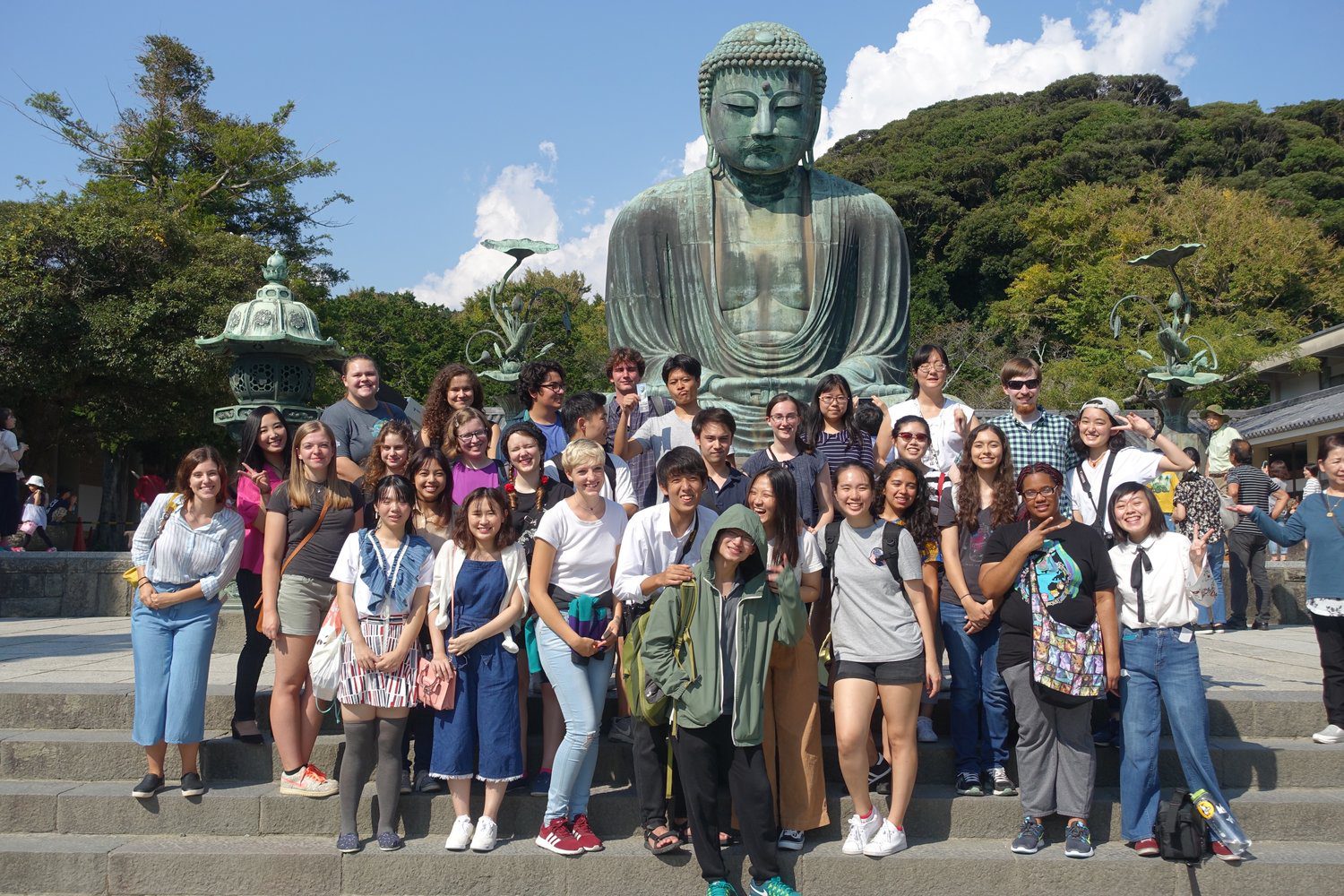
Semesters abroad. Faculty exchanges. Alumni trips. Teaching internships. Public film screenings. All of these ongoing activities represent Earlham’s vibrant and varied connections to Japan and the Japanese community in Indiana, and the deep link between the college and the country that goes back a considerable 140 years — when Earlham College alums Joseph and Sarah Ann Cosand went to Japan as a missionaries and founded what is now the Tokyo Friends School.
Since then, Earlham students and staff have kept the bond strong, both through academic work and the professional careers that followed. And it continues to evolve in new directions.
The College hosted the 2026 Japanese Olympiad of Indiana, the first time since 2018, and will do so again for the next two years. The annual competition, held each February, brings together high school students from across the state to test their knowledge of Japanese language and culture. The high-drama face-off lasts just one afternoon, but the preparation takes months. A committee from the Association of Indiana Teachers of Japanese, which organizes the event, sends out study guides well ahead of time so the students can prepare.
One contest day, they might be asked to translate dialogue or pinpoint a Japanese city on a map or answer questions about age-old proverbs. For the first time in the event’s history, there will be actual prizes, making the stakes a bit higher for the participants.
“Every member of the teams that make it to the finals has the chance to apply for a $1,500 scholarship to Earlham,” said Yasumasa Shigenaga, an associate professor of Japanese language and linguistics at Earlham and a member of the Olympiad’s organizing committee.
Those scholarships are supported by the Newton K. Wesley Foundation, which got on board as a sponsor after Earlham agreed to host the competition for three consecutive years. It’s the first institution to make that kind of commitment, said Dyron Dabney, who directs Earlham’s Institute for Education on Japan and was a key force behind the effort.
The Institute, which was created in 1986, plays a crucial role in the ecosystem of Earlham’s Japanese programs and its tasks are varied. There is a community aspect to Dabney’s work — the institute serves as a public liaison between the College and the region, raising funds to support study abroad programs, arranging and consulting with Japanese businesses establishing operations in Indiana or Indiana businesses looking to enrich relationships in Japan. It sponsors an annual lecture series and supports community events, such as a screening of Japanese films.
On the ground, working across the two countries, it also builds relationships that help Earlham students who study in Japan find jobs as teachers if they choose to stay in that country.
One model of success for that effort is Daniel Stifler ’02, who has been working as a teacher at the Friends School in Tokyo since the summer after graduation. He has now been a resident of Japan for more time than he lived in the U.S.
“Being at Earlham helped me to learn not only how to speak Japanese but also how to listen to people, to take people seriously, and to be curious about how they see the world,” Stifler said via email from Japan. “It is that ability to listen, I think, more than any ability that I have to speak Japanese, that has helped me to find a meaningful life and career in Japan.”
Earlham now has a small, permanent staff in Japan and its programs are robust. Students have multiple options for the time they spend there, explained Robb King, senior director of Japan programs.
Some take classes at Waseda University in Tokyo. Others participate in Earlham’s Studies in Cross-Cultural Education program (SICE), headquartered in the city of Morioka. SICE provides students a deeper immersion in the culture, staying with local families and working as English teachers for younger students.
Beyond that, Earlham is a regional leader in the U.S. in the area of academic exchanges, coordinating Japan programs for about 20 schools in the Great Lakes Colleges Association. That includes overseeing the study experiences for as many as 50 students per year, King said. Nearly two dozen Earlham students study or complete summer internships in Japan each year, and Japanese students attend Earlham in return. That goes back to 1893, when Chuzo Kaifu became the first Japanese man to earn a bachelor’s degree at Earlham. In 1896, May Morikawa became the first Japanese woman to earn an undergraduate degree at Earlham, according to extensive research on the topic done by Tom Hamm, professor emeritus of history and Earlham’s Quaker scholar-in-residence.
Earlham alums have undertaken notable activities in Japan that cross beyond the academic and into the political. One example: Esther Rhoads, who graduated in 1917 and later served as a tutor to the Japanese Crown Prince.
Another: Bonner Fellers, who graduated in 1916, went on to study at the U.S. Military Academy at West Point. He later acted as a key advisor to General Douglas MacArthur on Japanese matters in the aftermath of World War II.
Other connections have mirrored the peace-minded Quaker values that have long-driven Earlham’s mission. In 1927, as anti-Japanese sentiments were swirling the U.S., Earlham students raised money to send Wilfred V. Jones as a goodwill ambassador to study at Tokyo Imperial University, now the University of Tokyo.
When Japanese Americans were being sent to internment camps in the western U.S. in the 1940s, Earlham students and alums intervened again, inviting Japanese Americans to study on campus and avoid confinement. Over the years, other notable Earlham figures served as advocates for the relationship, including Landrum Bolling, Jackson Bailey, Wendell M. Stanley ’26, Gordon T. Bowles, Barbara Ruch, Chuck Yates, and Richard Wood.
Formal exchanges of students and faculty started in 1963, and have continued in various forms, including a three-week residency for Earlham faculty at the Tokyo Friends School. That exchange fell off for some years (due partly to the Covid pandemic) but was resurrected in 2025, when Dabney went there as a scholar-in-residence, using the time to teach but also to build pipelines for students there to attend Earlham after they graduate.
Dabney’s trip is just one of the ways the Earlham-Japan connection remains dynamic today, and it still goes both ways. Toru Shinoda, a professor from Waseda University, is in residence for the 2025-2026 academic year at Earlham, teaching courses about the history of Japanese companies in the Midwest. He has spent time in Earlham’s archives going through papers, including those collected about Bailey, a former history professor who helped establish a program in East Asian Studies on campus, and was registered as a conscientious objector in the 1940s.
“I feel like I was sent here to renew the bridge between two significant peacemaker schools over the Pacific,” said Shinoda. “It was meant to be.”
The connection also continues through the links that many students who passed through exchange programs have kept active through their lives and careers, including Jay Coffman ’02 who has worked with Japanese automobile companies both in Japan and the U.S.
In October, Coffman, who now lives in Columbus, Ohio, organized a reunion in Tokyo, near Waseda University, and invited anyone who had been through exchange programs to attend. He said he was “blown away” when 38 people quickly signed up. Students and faculty from across three decades got reacquainted with old colleagues or met new ones who had shared overlapping educational and work histories.
“The feedback has been overwhelmingly positive about what a great experience it was,” he said. But at its core, the connection stays the most vibrant through the waves of students who cross continents every year, not just to study language and history, but to get to know a culture a world away first-hand. That includes people such as Grace Russell ’26, a senior in Japanese studies who recently completed the Japan Study program at Waseda University.
“I was able to study abroad in Japan and live with a host family for 10 months,” she said. “That experience was invaluable, and my knowledge of both the language and culture greatly increased from it.”
Story written by Ray Mark Rinaldi. Photos courtesy of Earlham College Archives.
Editor’s note: This story was originally published in the spring 2026 edition of Earlhamite magazine.
***
About Earlham College
Earlham College and Earlham School of Religion foster a collaborative learning community that inspires and motivates students with transformative opportunities and experiences so they can become catalysts for good in a changing world. Located in Richmond, Indiana, Earlham is one of U.S. News & World Report’s Top 100 national liberal arts colleges and offers one of the top 20 classroom experiences in the nation, according to the Princeton Review.
Media contact
Brian Zimmerman
Assistant vice president of strategic communications
Email: [email protected]
Phone: (765) 983.1256